


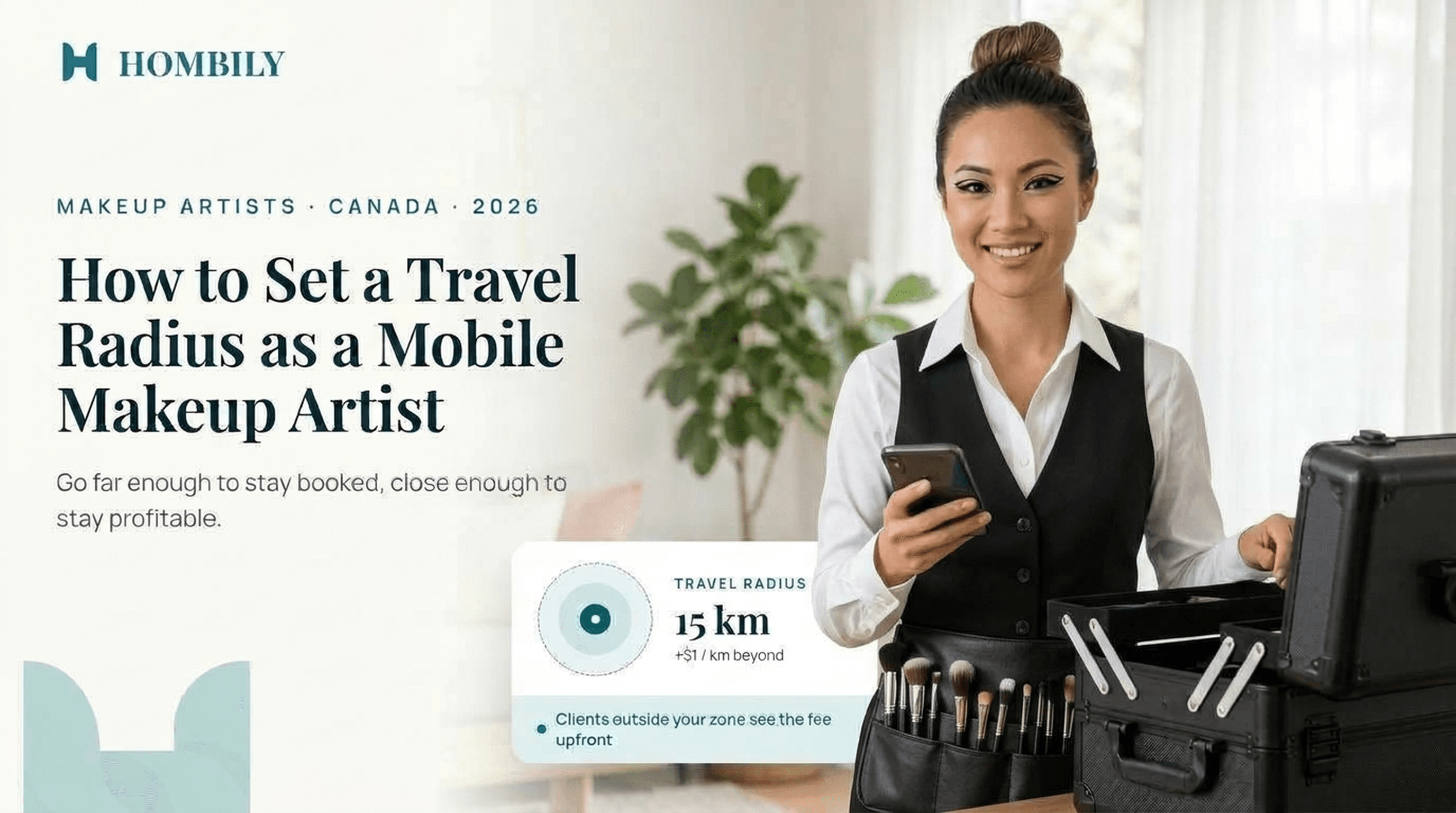
Set a mobile makeup artist travel radius around journey time, costs and client needs. Plan reliable home visits without overextending your working day.
Set your travel radius as a mobile makeup artist around the time an appointment takes door to door, not just the distance on a map. Start with an area you can serve reliably, account for parking and carrying your kit, and confirm each address before promising a start time.
TL;DR
Your client wants to feel ready for the occasion, not rushed by your next booking. A realistic travel area helps you arrive prepared while keeping the rest of your day manageable.
If you are still building your business, start with the broader guide to becoming a mobile makeup artist in Canada. This article focuses on a narrower decision: which journeys belong in your working day, and which need a different arrangement.
Your best service area is the one you can honour consistently. A nearby address with difficult access can be less practical than a farther appointment on a straightforward route. Treat your travel radius as a planning boundary rather than a promise that every address inside it works equally well.
Use a map to sketch a starting area, then test the actual journeys at the times you expect to work. Your final boundary should reflect your transport, appointment length and commitments before and after the visit.
Plan from where you normally collect your kit and begin work. That might be your home or another regular base. A city-centre map pin is not helpful if you actually start on the other side of town.
Check the return journey as well. Your last appointment has to fit the trip home, not just the outward journey. If you work from different bases on different days, keep those days separate when you assess addresses.
You do not need to share your home address publicly to describe your service area. Name the neighbourhoods or areas you cover, then keep your exact starting point in your own planning notes.
Before drawing a boundary, record:
A route that looks easy in the middle of the day can be a poor fit for an early bridal start or a return trip during busy periods. Check the route for the intended day and arrival time rather than relying on the estimate shown when you first open the map.
Compare the practical route with the straight-line distance. Bridges, transfers and street layouts belong in your decision. Do not assume that two clients the same distance from your base require the same travel allowance.
For your 2026 service-area notes, save both the expected journey and the conditions you checked. A route estimate is a planning aid, not a guarantee. Recheck it when the client confirms the address or changes the appointment time.
Arrival at the building is not the same as being ready to work. You still need to reach the client, position your equipment and prepare your workspace.
Ask about the entrance, parking or drop-off point, stairs and lift access. For hotels or event venues, confirm where the appointment will happen and whether someone needs to meet you. A venue name alone does not tell you how to reach the room with your kit.
Keep a clear sequence in your diary:
You are not adding unnecessary complication. You are allowing for the work that surrounds the makeup itself.
A longer trip needs a business reason, not just an open slot in your calendar. Include the complete time commitment and the costs you will actually incur before deciding whether to accept it.
List transport, parking and any other trip-specific costs separately from products used during the service. Also consider the appointments you cannot take while travelling. A journey can be physically possible and still be a poor use of your working day.
Avoid copying another artist's radius simply because you offer similar makeup services. Their transport, working hours and client mix can be different. Use your own completed appointments to test whether your boundary is realistic.
If a booking comes through a marketplace, check its current travel and booking terms before making a separate arrangement. This guide does not set or describe Hombily's travel-fee policy.
Keep a clear regular service area. Assess journeys beyond it individually rather than quietly expanding the boundary every time someone asks.
A special request should still fit your travel time, equipment needs and next commitment. Confirm the full arrangement before treating it as accepted. Do not let an exception become an expectation for future bookings at other addresses.
For a 2026 planning sheet, the following structure keeps the decision simple:
| Coverage approach Best for Advantage Limitation |
| Named neighbourhoods | A compact, familiar area | Easy for clients to recognise | Edges still need an address check |
| Travel-time boundary | Routes with uneven journey times | Reflects your actual working day | Estimates change with timing and conditions |
| Distance boundary | A simple starting map | Easy to sketch and explain | Does not capture access or traffic |
| Individually assessed trips | Occasional visits outside regular coverage | Leaves room for suitable requests | Needs a fresh check before acceptance |
Use distance to sketch the area and journey time to decide whether a booking fits. This gives you a simple public explanation without allowing a circle on a map to run your diary.
Do not assess each booking as though it is the only visit of the day. The journey between clients matters just as much as the journey from your base.
Before confirming a second address, check the first appointment's finish, packing time, onward travel and setup at the next stop. If the sequence depends on everything going perfectly, move the booking or decline it.
For bridal work, confirm the required ready-by time as well as the requested start. The client's deadline should shape the plan from the beginning. A travel boundary is useful only if it leaves room to deliver the service calmly.
Give clients a clear area, then explain what you need to confirm a visit. Keep it welcoming and specific. A long list of restrictions is no substitute for a reliable booking conversation.
Your message should cover your usual neighbourhoods, the need for an exact address and whether you consider trips outside regular coverage. State any travel arrangements before confirmation, using the rules of the booking channel you are working through.
Avoid publishing a universal travel promise you cannot honour at every time of day. Equally, avoid making clients guess whether they are within reach. A short service-area note followed by an address check is easier to understand than a vague claim that you travel everywhere.
Review this wording alongside your 2026 appointment information so your profile, messages and diary describe the same boundaries.
The boundary changes because the work around an appointment changes. Review these factors rather than searching for a single standard distance for every artist:
In your 2026 review, compare what you planned with what actually happened. If a particular journey repeatedly squeezes the next appointment, change the boundary or reserve that route for a different part of the day.
A marketplace can provide a place to connect with clients, but it does not replace your judgement about the journey. You still need a workable address, timing and service arrangement.
Hombily is a marketplace for at-home beauty and wellness services. Hombily Partner is relevant to mobile makeup artists seeking a way to connect with at-home clients. Read the Hombily Partner information and confirm the current terms before deciding whether it fits your business.
The benefit is a channel designed around at-home services. The limitation is that joining a platform does not make every journey practical or guarantee bookings. Keep your own travel boundaries clear, whatever channel a client uses to reach you.
Accept a longer journey only after checking the full appointment and its effect on the rest of your day. A larger group or a different start time can change the decision, but neither removes the need to plan the route.
If the trip does not work, offer a time that does or explain your boundary plainly. Saying no early is better than accepting a visit you cannot deliver reliably.
Review your area when you change transport, move your base or find that actual journeys differ from your plan. Check it before opening new dates with unfamiliar routes or venues.
Keep a brief note after visits: expected travel, actual travel, access problems and whether you had enough setup time. Those notes give your next decision a firmer basis than memory alone.
1. How far should a mobile makeup artist travel?
A mobile makeup artist should travel within an area that fits the complete appointment and the rest of the working day. There is no distance recommended by this guide for every
artist; check your own routes, costs and commitments.
2. Should I use kilometres or minutes to set my service area?
Use kilometres to sketch a starting area and minutes to check whether a particular journey fits. Travel time captures route differences that a distance boundary misses.
3. Does my travel radius include the return journey?
Your planning needs to include the return journey or the trip to your next client. A service-area boundary alone does not account for those commitments.
4. What should I ask before confirming a home makeup visit?
Ask for the exact address, appointment timing, ready-by deadline and access details. Check parking or drop-off, stairs and the workspace before finalising the journey.
5. Can I make exceptions for bridal parties outside my area?
You can assess a bridal request individually if the full trip and service fit your diary. Confirm the ready-by deadline and all travel arrangements before accepting.
6. Does Hombily set the travel radius recommended in this guide?
No. This guide provides general planning advice for independent mobile makeup artists, not a Hombily platform rule. Check current partner terms for booking-specific
requirements.
A straight-line radius is a useful drawing tool, but your client experiences an arrival time. For your next 2026 booking, check the journey from the previous commitment all the way to being ready at the client's chair. That is the boundary worth protecting.